
One of the biggest misconceptions about leadership in equipment dealerships is that strong leaders “jump in and do whatever needs to be done.”
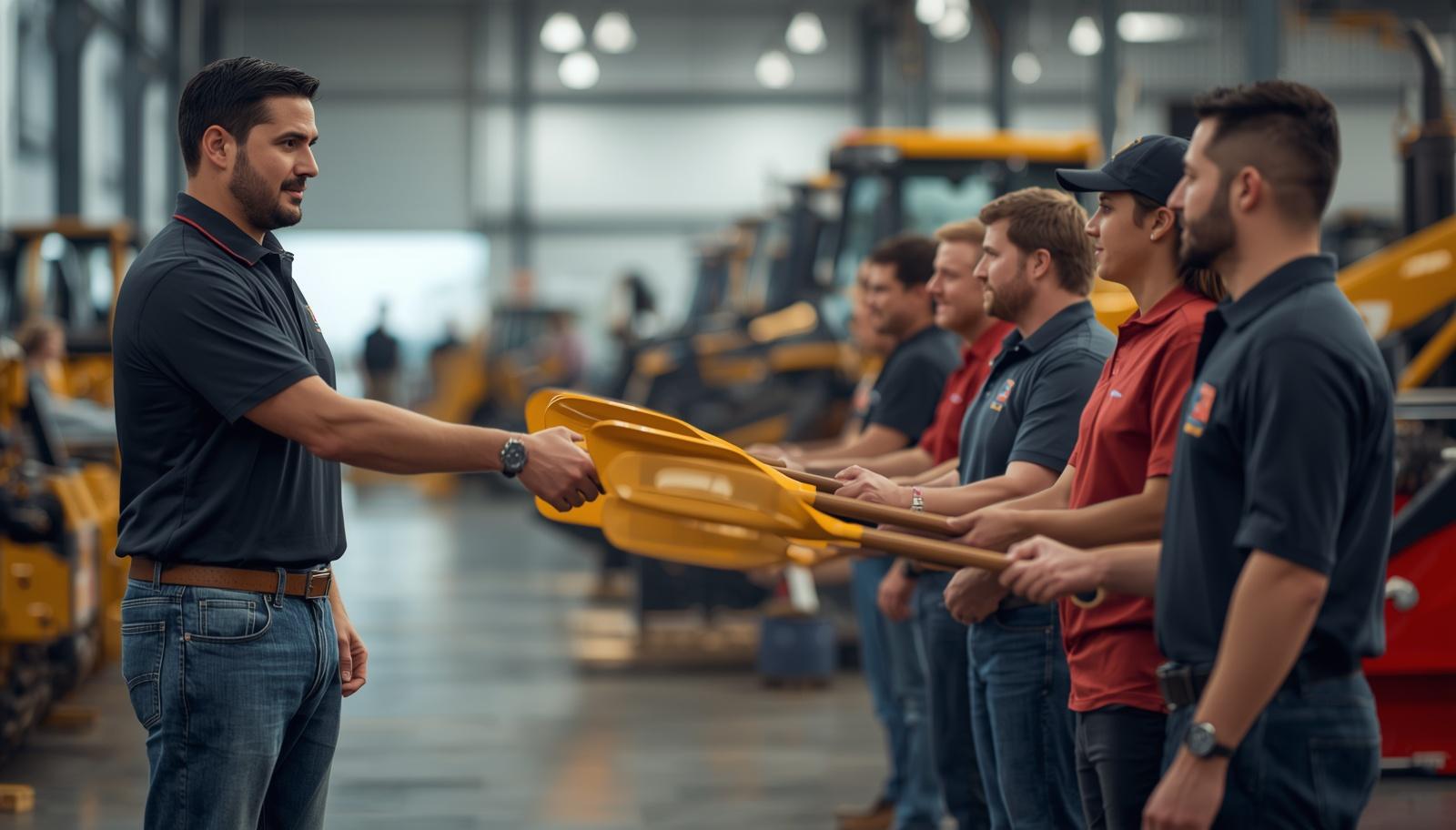
It sounds admirable. It feels supportive. It even feels like leadership. There is a time and place for that. However, dealer leaders should be steering the boat instead of doing all the rowing.
When leaders constantly grab the oars themselves, they unintentionally create a team that waits instead of rows. Employees begin to assume that when things get difficult, someone above them will step in and solve it. Decisions move upward. Accountability becomes unclear. The leader works harder, but the organization doesn’t necessarily move faster. Strong leaders and dealerships operate differently.
In reality, effective leadership in a dealership isn’t about rowing harder than everyone else.
It’s about making sure everyone else has an oar.
Strong leaders are in the oar-distribution business. Their job is to ensure every seat in the boat has the clarity, responsibility, tools, and expectations needed to contribute to the direction of the dealership.
Because when everyone rows, the boat moves.
When only the leader rows, the boat struggles.
A clear example of this shows up in training sessions with dealership managers. Problems always come up, but you can quickly see who left a capable team behind and who didn’t. Some stay in the room and keep learning. Others miss half the training because they are out in the hallway on the phone, dealing with issues back at the dealership, like someone calling off or a customer problem.
Everyone Has to Be in the Boat
Alignment begins with a shared understanding of where the dealership is headed and what success actually looks like.
Too often, leadership teams assume the organization understands the plan simply because it was discussed in a leadership meeting or presented in a quarterly review. But if technicians, parts managers, salespeople, and support staff cannot clearly articulate the dealership’s priorities, alignment doesn’t truly exist.
Dealership leaders improve this by:
Clearly communicating priorities and success metrics so every employee understands what winning looks like.
Translating strategy into relevance for each department and role. A parts specialist needs to understand how inventory accuracy supports uptime. A service advisor needs to see how scheduling efficiency strengthens customer relationships.
Creating space for questions and discussion so people understand not just the what, but the why behind the direction.
People will get in the boat when they know where the boat is going.
No Passengers, Everyone Needs an Oar
In a dealership, an oar represents responsibility and ownership.
Every seat on the boat matters. Sales generate opportunity. Service protects uptime and customer trust. Parts support both. Administration keeps the entire operation functioning.
But clarity around expectations determines whether those functions move together or drift apart.
Dealership leaders strengthen alignment by:
- Defining clear role expectations with measurable outcomes.
- Eliminating role ambiguity that allows work to fall between departments.
- Addressing performance issues directly instead of allowing them to persist.
When someone doesn’t have an oar, someone else eventually has to row harder.
When Someone Isn’t Rowing, the Whole Boat Pays
Every dealership has experienced it: one person disengaged, unclear, or underperforming while others compensate to keep things moving.
Over time, this creates two problems.
Performance drops and morale drops even faster. High performers begin to feel like their effort is being used to cover for someone else’s lack of contribution. Eventually, they either burn out or disengage themselves.
Effective leaders prevent this by:
- Establishing clear accountability rhythms, priorities, performance dashboards and regular check-ins.
- Addressing performance gaps directly early, often and respectfully before they become accepted behavior. After behavior becomes a habit is it much harder to change.
- Protecting high performers from consistently carrying extra weight.
When everyone rows, the boat moves faster. When only a few people row, the boat eventually stalls.
People Rowing in Different Directions
Sometimes the bigger problem isn’t that people aren’t working, it’s that they’re working in different directions.
In equipment dealerships, misalignment often shows up between departments:
- Sales pushing volume that service capacity cannot support
- Parts inventory decisions that don’t align with service demand
- Service scheduling that creates friction for both customers and technicians
People can work incredibly hard and still move the dealership sideways.
Leaders prevent this by:
- Aligning KPIs and incentives across departments so teams support one another rather than compete with one another.
- Reinforcing cross-department understanding of how decisions affect the entire dealership.
- Simplifying priorities so teams focus on what truly matters.
Rowing harder doesn’t help if everyone is rowing in different directions. If the team is misaligned, the boat will go in a circle while everyone is still rowing.
Rowing in the Same Direction Requires Rhythm
Alignment is not a one-time event created during a strategy meeting. It requires rhythm.
Just like a rowing team moves most efficiently when strokes are synchronized, dealership teams perform best when communication and accountability happen consistently.
Strong leaders create rhythm by:
- Establishing regular leadership and departmental alignment meetings.
- Reviewing priorities and performance indicators on a predictable cadence.
- Reinforcing behaviors that strengthen teamwork across the dealership.
Consistency creates coordination.
The Leader Steers While the Team Provides the Power
The leader’s role is not to sit idle, but it also isn’t to grab every oar. Leadership is about steering.
That means paying attention to what’s ahead: market conditions, staffing needs, service capacity, inventory levels, and manufacturer expectations. It means making adjustments early instead of reacting late.
Dealership leaders steer effectively by:
- Looking forward rather than constantly reacting.
- Making course corrections when indicators suggest drift.
- Protecting the organization’s focus by saying no to distractions that pull energy away from the plan.
The team provides the power. Leadership provides the direction.
Go Give Everyone an Oar
Leadership in equipment dealerships isn’t about rowing harder than everyone else. It’s about making sure every seat in the boat has an oar.
When everyone understands their role, rows in the same direction, and works within a clear rhythm, the dealership moves faster with less wasted effort.
And when that happens, leaders are free to focus on steering the course instead of doing all the rowing themselves.
Sounds simple, but is it happening in your dealership?